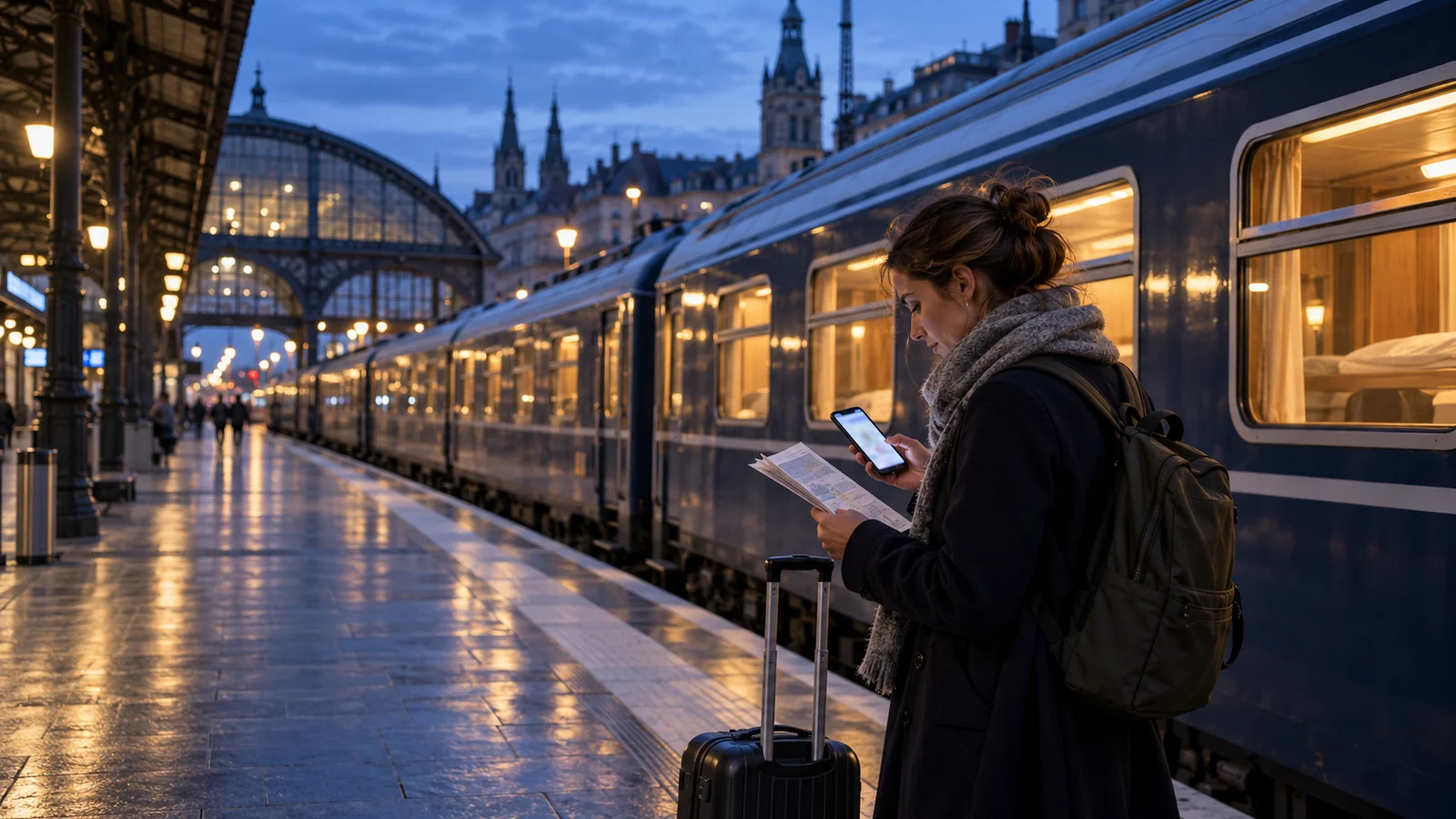
A night train is not simply a daytime train running after dark. Price and experience depend on the accommodation — seat, couchette or sleeper — while a booking mistake can leave you with separate tickets, an unprotected connection or a berth unlike the one you expected.
These checks do not rank operators or routes. They help you understand exactly what you are buying and where risk remains.
1. Check whether the overnight segment is direct
Inspect train numbers, stations and every change. “Sofia to Paris” in a search result may combine several services, with the night train covering only part of the journey. Record separately:
- the daytime feeder train;
- the overnight segment;
- the morning connection;
- minimum transfer time and any station change.
Do not assume that one long itinerary means one protected connection.
2. Establish whether you have one contract or separate tickets
This is the most important transfer check. Your Europe explains that rights after a delay and missed connection depend on whether the journey was issued as a through-ticket. Protection may differ after separate purchases.
Look for explicit confirmation in the booking, not merely one checkout screen. If tickets are separate, allow a larger buffer and check what happens if the first train is late.
3. Choose accommodation for the actual need
The main categories are not interchangeable:
- seat — least personal space and normally no horizontal bed;
- couchette — a basic berth in a shared or private compartment, depending on product;
- sleeper — a bed with more service/privacy according to category;
- private compartment or mini cabin — a distinct product with its own capacity and rules.
Inspect images and the description of the exact product, not only the operator’s general page. “Sleeping berth” does not automatically mean a private compartment, en-suite facilities or included breakfast.
4. Check who shares the compartment
Before payment, see whether you are buying one berth or the whole compartment, how many passengers it accommodates and whether special categories apply. Couples, families and groups should not assume that places in one order will be together unless the confirmation says so.
Nightjet, for example, separates seating, couchette and sleeper products and also sells whole compartments; conditions for children, bicycles and animals differ. Another operator may use different names.
5. Confirm the reservation is included
Reservations are compulsory on many night trains. Interrail says reservations are generally mandatory for night trains and are not automatically included with a Pass. Nightjet likewise requires Interrail/Eurail holders to reserve their chosen category.
Check that your documents provide both the right to travel and a specific seat or berth. Pass, ticket and reservation can be separate documents.
6. Compare the final price
Add the ticket, reservation, accommodation, feeder segments and extras for a bicycle, animal or vehicle. Reservation fees can differ by route and sales channel, while indicative prices may change.
The cheapest fare often has tighter conditions. Nightjet’s official information, for example, distinguishes more flexible Standard tickets from limited Sparschiene fares and says price and availability depend on demand.
7. Read change, cancellation and ticket-format terms
Check the cancellation deadline and fee, whether date or category can be changed and when the ticket becomes non-refundable. Do not infer the rules from the word “Flex” alone.
Nightjet terms can even differ according to whether an online ticket has already been received as a PDF. This illustrates why you should retain the applicable terms at purchase instead of trying to reconstruct them after a problem.
8. Verify times, station and arrival date
A night train departs on one date and arrives on the next. Check the time zone, exact station and whether the morning connection leaves from the same station. Sales may open later around the annual timetable change; Nightjet notes that its usual window of up to 180 days can be shorter around the mid-December change.
Avoid committing to a non-refundable hotel or flight based only on a provisional timetable without considering change risk.
9. Check luggage, bicycles, animals and accessibility
Confirm baggage storage, bicycle capacity and animal rules. Check step-free boarding, toilets and a suitable compartment if these matter to a traveller. Such facilities are limited and cannot be assumed for every carriage.
If specific assistance is required, contact the operator in advance and keep the confirmation.
10. Save evidence and a Plan B
Download tickets for offline access, retain the booking number and save a copy of the terms. Record the operator for every segment and its support channel. With separate tickets, prepare a realistic alternative for a missed connection.
Delay rights depend on circumstances and the ticket. Your Europe describes rerouting, reimbursement and compensation options, but conditions and exceptions apply. Do not assume automatic compensation; first establish which contract and operator govern the journey.
Final checklist
- [ ] Every segment and transfer is clear.
- [ ] Through-ticket or separate-ticket status is confirmed.
- [ ] Accommodation and compartment sharing are confirmed.
- [ ] Ticket and mandatory reservation are present.
- [ ] Final price includes all extras.
- [ ] Change, cancellation and refund terms are read.
- [ ] Date, station, time zone and morning connection are checked.
- [ ] Luggage and special requirements are accepted.
- [ ] Documents are saved offline.
- [ ] Plan B matches the connection’s real protection.
The key principle
Do not buy a vague “night train”. Buy a precise package: route, contract, accommodation, reservation and terms. When each element is clear before payment, a low fare is less likely to conceal an expensive logistical risk.